Lab-Grown Diamond Pendant Necklaces: The 2026 USA Buying Guide
 Oliver Brandt
October 12, 2026
9 min read
A lab-grown diamond pendant necklace is the most quietly powerful piece in a modern jewellery box. It sits exactly where the eye lands, moves easily from a slim crew-neck tee to a black-tie gown, and because the diamond is grown in a laboratory rather than mined, it delivers the same optical and chemical brilliance as a natural diamond at a fraction of the price. If you are shopping from the United States in 2026, this guide walks you through chain lengths, carat sizes, setting styles and real pricing so you can choose with confidence.
Why Lab-Grown Diamonds Make Sense for a Pendant in 2026
A pendant is a daily-wear piece, which is exactly why lab-grown diamonds have become the default choice for US shoppers this year. You are buying sparkle, security and a metal you will touch every single day rather than rarity alone. Because lab-grown stones cost materially less per carat, your budget stretches to a larger, better-cut diamond and a heavier solid-gold setting.
- Identical composition. Lab-grown diamonds are real diamonds — same carbon crystal structure, same 10 on the Mohs scale, same fire and brilliance.
- More sparkle per dollar. Spending on cut quality instead of mining scarcity is the fastest route to visible brightness.
- Transparent sourcing. Every stone is traceable from laboratory to setting, which matters to a growing share of American buyers.
- Solid gold durability. 10K and 14K gold settings hold their shape and resist the knocks of everyday wear.
Choosing the Right Chain Length for Your Neckline
Chain length controls where the diamond sits on your chest, and that single decision changes how a pendant reads. Too short and it competes with your collarbone; too long and it disappears beneath a neckline. Use the table below as a starting point, then check the model photos on each product page.
| Length | Where it sits | Best worn with |
|---|---|---|
| 16 inches | At the base of the throat (choker) | Open necklines, v-necks, turtlenecks |
| 18 inches | On the collarbone — the US default | Almost everything; ideal for first pendants |
| 20 inches | Just below the collarbone | Boat necks, buttoned shirts, layering |
| 22–24 inches | Mid-chest | Sweaters, high necklines, solo statements |
An adjustable chain with a two-inch extender is the safest gift choice, because it lets the wearer fine-tune placement without a resize.
Carat Size and How It Looks on the Neck
Pendant carat weights behave differently from earring or ring carats because the stone is seen face-on and rarely side-on. As a rule of thumb, the diameter in millimetres matters more than the number on the tag.
| Carat weight | Approx. diameter | Everyday presence |
|---|---|---|
| 0.10–0.15 ct | ~3 mm | Subtle, ideal for a second or third layer |
| 0.25 ct | ~4.1 mm | The most popular everyday size in the US |
| 0.50 ct | ~5.2 mm | Clearly visible, still office-appropriate |
| 0.75–1.00 ct | ~5.9–6.4 mm | A statement that reads from across the room |
If you want maximum visual size within a budget, prioritise a well-cut 0.25–0.50 ct stone in a bright setting over a poorly cut larger stone. Cut quality is what the eye actually registers.
Bezel, Prong and Solitaire Settings Compared
Bezel set
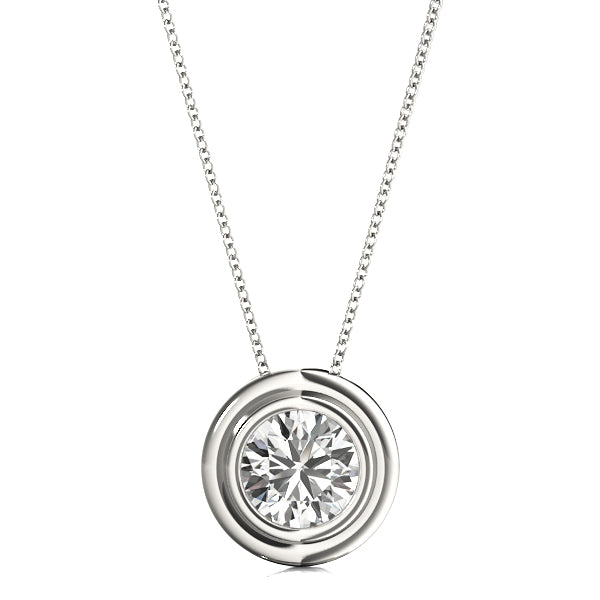
A smooth rim of gold wraps the girdle of the diamond. Bezels are the most secure and snag-free choice, which makes them the best option for anyone who wears a pendant around children, pets or a keyboard. They also give a clean, modern silhouette.
Prong set
Four or six claws lift the diamond so light enters from every angle. Prong-set pendants show the most brilliance and read slightly larger than the same stone in a bezel.
Solitaire drop
A single diamond suspended from a fine bail creates gentle movement and catches light as you turn. It is the most traditional and the most wedding-appropriate of the three.
Explore the complete diamond pendant collection to see each setting photographed on a model.
USA Price Guide for 2026
Lab-grown diamond pendants in solid gold typically fall into these US price bands. Exact prices depend on diamond weight, metal karat and chain length.
| Tier | Typical spec | US price range |
|---|---|---|
| Entry everyday | 0.10–0.20 ct, 10K–14K gold | $149 – $299 |
| Signature | 0.25–0.50 ct, 14K gold, 18 in chain | $279 – $549 |
| Solitaires & statements | 0.75 ct and up, 14K or 18K gold | $649 – $1,800+ |
Free shipping and returns apply on US orders over $250, and delivery typically lands within 3 to 5 days. Use code WELCOME10 for 10% off a first order.
Styling and Caring for a Diamond Pendant
A pendant is at its best when it is the only piece telling the story. With a crisp white shirt, let a single pendant do the work. With a summer dress, layer a 16-inch chain against an 18-inch pendant so the two stones sit in different planes and sparkle independently. Skip the pendant entirely under heavily beaded or embellished necklines.
To care for the piece, wipe it with a soft dry cloth after wear, clean it gently every few weeks in warm water with a drop of mild soap and a soft brush, and store it flat in a felt pouch so the chain does not kink. Have the setting checked once a year if you wear it daily.
Where to Start
Decide on three things in order — chain length, carat size, then setting — and the choice becomes straightforward. A 0.25 ct bezel pendant on an adjustable 18-inch chain is the most versatile first purchase; a 0.50 ct solitaire is the piece you keep and pass on. Browse every option in the lab-grown diamond pendant collection, then read more fine jewellery guides before you decide.